Your designers get their calendar back.
A price change should be one edit, not one edit per file per location. Menuology™ is how multi-unit restaurant and hospitality groups author, price and publish their menus: one change reaches every location on the day it takes effect, and the file that comes out matches the design it came from.
Currently serving national chains, fine-dining groups, and luxury hospitality brands.
The problem
Most menu software was built for screens. Yours goes to a printer.
It is typeset, not rendered.
A menu is a printed object with a design standard and a print bill. It has to reproduce exactly, the same weights, the same spacing, the same rules, at every location, whether the run is a handful of menus or a pallet of them. Software that treats a menu as a web page and offers “print to PDF” produces something that is nearly right, which on a press is another way of saying wrong.
And it is true in six places at once.
The designer’s files, a spreadsheet of prices, an email thread about the specials, the point of sale, the website, and whatever the Denver store actually printed last Tuesday. Nobody can say which one is the menu, so somebody spends their week reconciling them, and the print run is where the differences show up.
The brand team answers for what is on the table and cannot see it. Finding out what actually printed in every dining room means sending someone, or waiting for a guest to post the photo.
Menuology is one place the menu is true, and a reliable path from there to the printer. We have been solving both problems, for this kind of operator, since 2006.
What it does
Built around the parts that are expensive to get wrong.
Every item, kept once
Every item, description, price and modifier is kept once, in one library, and every menu in the group draws from it. Change it once and it is right on every menu that carries it. Nothing is retyped from a spreadsheet, nothing drifts between locations, and what changed, where and by whom is on the record.
Press-quality output, and the file is yours
Your menus come out at true print specification: the typography, the spacing, the placement your designer intended. The scheduled run prints in house or at your commercial printer, whichever way you work; the salmon that just ran out gets pulled and reprinted in the back office before the next guest sits down. Your printer stays your printer. Menuology produces the file, and where it gets printed is your decision.
Price control across every location
Change one item's price at one restaurant, or every price across the country, or anything between the two, never forced into a sweeping update when you meant a single number. Stage it ahead of the date, push it exactly as far as it should go, and roll it back if it's wrong.
A record of what actually printed
Every publish is logged: which menu, which locations, which version, when, and by whom. When someone asks what the Denver store had on the table last Tuesday, the answer is in the system rather than in somebody's memory.
Your structure, not ours
Items and prices are assigned wherever they actually belong: nationally, by region or state, by market or concept, by a group of locations you define, or at one individual restaurant. Menuology adapts to how your chain is organized. You do not reorganize your chain to suit Menuology.
Local beverage programs that stay on brand
Beverage is where a national brand meets a local market. The list that sells in Portland is not the list that sells in Miami, and it shouldn't be. Locations maintain their own wines, local taps and seasonal cocktails while corporate keeps the core pours, the section structure, the typography and the layout. The result reads as though corporate designed it, because corporate did.
The system
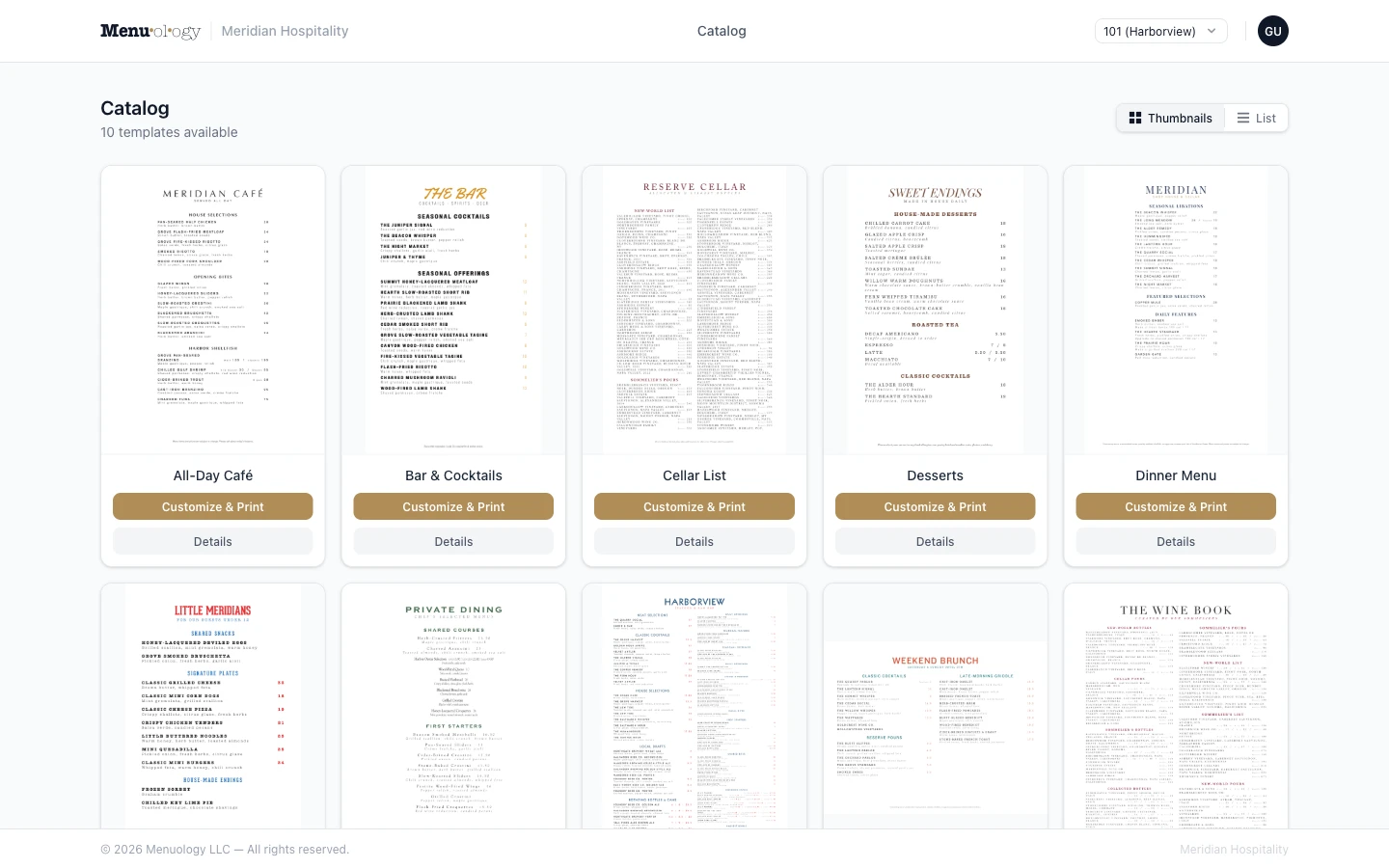
One library. Every location. Every menu.
This is where your menu program lives. Every item, price, description and modifier is kept once, by the people who own it, and every menu in the group is drawn from it: the corporate template, the market pricing, the local wine list, the section one location doesn’t carry.
Locations see the menus that apply to them, change what they’re permitted to, and print. The file that goes to press is what the program produces, and everything that happens on the way is recorded: what published, where, when, and by whom.
What makes us different
We don’t sell printing, and we don’t sell websites.
Most menu systems come attached to one or the other, and the software quietly steers you toward it. Menuology is the menu itself, ready for whichever printer and whichever website you already have.
Print agnostic
Menuology produces the finished, press-ready file; where it prints is your decision. The long run goes to the commercial printer you already use, the four o'clock reprint goes through the machine in the back office, and if you change printers next year nothing about your menus changes with it. Your print vendor is a supplier you choose, not a system you are tied to.
Web agnostic
Your website takes its menus straight from Menuology, so the price online is the price on the table. It does not matter what your site is built on or who builds it: your web team gets the finalized menu, exactly as it was published, and puts it wherever it belongs. Change agencies or platforms and the menu keeps coming.
Who we serve
Groups whose menus are a brand asset and a print budget.
These are the shapes of operation running on Menuology today. If one of them looks like yours, we should talk.
Hundreds of locations
National casual-dining chains
Menu sets that change on a corporate calendar, roll out to every market at once, and have to be right the first time because the print bill is measured in pallets.
Dozens of locations
Fine-dining and steakhouse groups
Seasonal and holiday programs, wine lists that move constantly, private-dining and banquet menus generated per event, and a design standard that will not tolerate approximation.
Restaurants inside a larger brand
Luxury-brand hospitality
Dining rooms operating inside a larger luxury brand, where the menu is a brand artifact and the typography is governed by the same standards as everything else the brand prints.
Menus that change with the delivery
Seafood houses and market-driven kitchens
Rooms where today's menu depends on what came off the boat this morning: the catch, the price, the count, all different from yesterday. The menu has to be reset, proofed and printed before service opens, every day, at every location, without waiting on anyone.
Menus that change mid-service
Wine-led and chef-driven rooms
The dish sells out at eight. The last bottle of a listing goes at nine. The item comes off, or its replacement goes on, and a corrected menu prints on the spot, so the next party is handed a menu that never offered what the room no longer has.
Several concepts, one operator
Regional multi-concept groups
One back office running distinct concepts with distinct menus, wine programs, and private-dining offerings, needing them separated where they differ and shared where they don't.
Menuology Private Label
Your system. Your data. Your menus, exactly as they are.
Private Label is how established groups run Menuology: a system of their own carrying your brand, your menu designs rebuilt exactly, and the capabilities your operation specifically needs.
Your own system, and nobody else in it
A Private Label client gets a system of their own, not an account inside software shared with other companies. Your menus, your prices and your people are yours alone. When your security team asks how your information is kept separate from everyone else's, the answer is that it was never in the same place to begin with.
Your templates, rebuilt exactly
Your existing menu designs are reproduced faithfully: the same typography, the same spacing, the same rules in the same places. Your printed menu should not change appearance just because you changed software.
Cutover without a launch weekend
Your existing process and Menuology run side by side, and we reconcile the output menu by menu and location by location until they match. Nothing is switched off until there is nothing left to reconcile, so the first print run is a scheduling decision, not an experiment.
Features built for you
Private Label clients get capabilities and reports built around how they actually operate, scoped as part of the engagement and switched on for them and nobody else. What is built for you is kept current as the software moves forward.
Let’s look at your menus.
Bring your printed menu. We’ll show you how it would be built, and what moving it would involve.